
Do you want to learn more about how your brain works?
Want help deciding on the best type(s) of neurofeedback for you?
Would you like a highly individualized intervention protocol based on your specific brainwave patterns?
Want to find out what medications or other interventions might best work for you, when nothing else has worked?

What is Brain Mapping?
Brain Mapping, or QEEG (Quantitative Electroencephalogram), is a form of assessment utilizing an EEG. This is a non-invasive test that records your brain waves in real time.
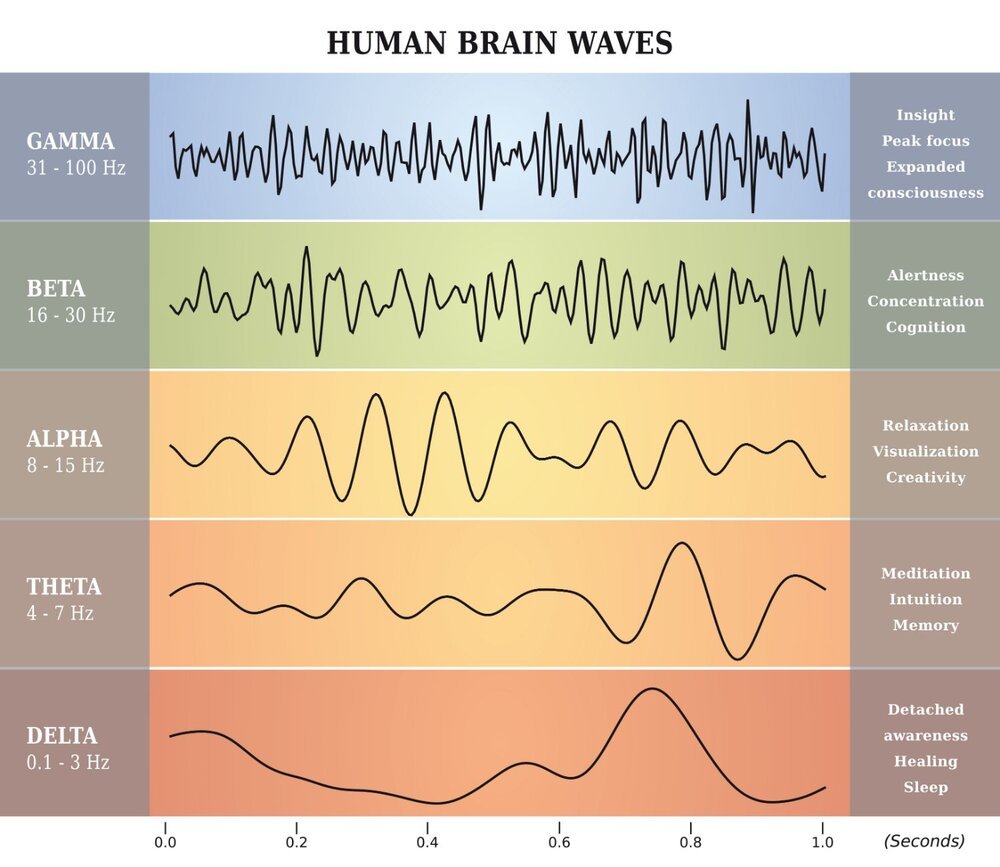
Brain waves are electrical signals produced by the brain. They are measured by counting the peaks in each second. Fast brain waves tend to be produced when you are awake, alert, or anxious. Slow brain waves are associated with lower activity levels, such as being relaxed, unfocused, or tired. The picture below provides an illustration of brainwave frequency patterns and their associated states.
How does a brain map work?
We record brain maps by placing a cap with 19 different electrodes on your head. Each brain area that is measured corresponds to clusters of symptoms that we will often later treat with neurofeedback.
The QEEG records your brains’s electrical signals (i.e., brainwaves) to determine if your brain is producing too much or too little electrical activity in a certain area. It will also tell us if your brain might be functioning inefficiently (which is often the cause of symptoms).
The brain map is essential for treatment planning. It helps us create a highly customized and individualized treatment plan specific to your brain. Through a brain map, we can determine with greater certainty which type of neurofeedback is most likely to help you (we offer two different forms of neurofeedback at our office).
Unlike most practitioners, who rely on a computerized z-score model of interpretation for the QEEG, Dr. Neff provides an advanced interpretation of the raw EEG. She identifies patterns of dysfunction by analyzing brainwave speeds and by identifying symptoms at specific areas of the brain that have been found in research to correlate with certain symptoms and biomarkers.
Brain maps, on their own, are not considered diagnostic. They do not map onto DSM-diagnoses, although they can reveal the presence of biomarkers related to certain disorders or presentations (e.g., indicators of trauma, autism and social perception differences, addictive tendencies, anxiety, obsessive thinking, inattention, and sensory processing differences, to name a few).
In our neurofeedback clinic, we most often use brain maps to create a customized neurofeedback protocol for our clients. This data assists us in creating and adjusting your neurofeedback protocol over time so that we can make evidence-based decisions about how to best help you thrive. We typically do a second brain map halfway through treatment to measure progress, and to determine if you need an amended treatment plan. Brain maps are also used in conjunction with psychological testing in our ADHD clinic to confirm or rule out a diagnosis of ADHD.
Brain mapping alone is not intended to diagnose a medical or psychological disorder. However, it can show us where symptoms are being generated in the brain so we can better target them. They can reveal the presence of biomarkers for issues related to trauma, autism, addiction, anxiety, attention, and sensory processing, to name a few. Within brain maps, images are generated that show “hot spots” in the brain that correspond to certain symptom patterns, similar to the images below.
